Spring Meadow corpse-incineration project
The Zone of InterestThe Spring Meadow corpse-incineration project turns the disposal of the dead into an administrative and technical operation: Paul Doll orders the remains burned and ground to conceal evidence, while the pyre’s smoke, heat, and pollution make that concealment visibly fail. Its account moves between orders, improvised engineering, and the corrupted landscape, showing how mass murder is managed as work—and how its material consequences escape the boundaries of the site.
Mandate and institutional pressures
The immediate order comes from Horst Blobel. Doll tells Wolfram Prufer that it comes from Blobel and therefore from the Reichsführer-SS, presenting compliance as a matter of hierarchy. Prufer objects that the task is impossible. Doll rejects the word as incompatible with the SS’s supposed ability to overcome objective conditions, but Prufer’s practical question—what purpose the work serves—exposes the uncertainty beneath the command.
Doll’s answer is political: the operation is intended to cover their tracks, and the ashes must also be ground in bone mills. The aim is not simply to dispose of bodies, but to remove traces that might later be examined. Prufer counters that concealment will matter only if Germany loses, a possibility the regime refuses to acknowledge. Doll admits that the same thought has occurred to him, yet insists that even victory cannot guarantee freedom from future questions. The project is thus organized around a contradiction: officials insist that the Reich will prevail while acting as though its crimes may eventually be investigated.
Doll describes Blobel as responsible for clearing an entire territory and says he repeatedly asks for Sonderkommando prisoners, using them up after each Aktion. Doll complains that Blobel will not make these forced laborers last longer. This exchange makes the human cost part of the administrative language: the prisoners are discussed as a depleted resource, while their assigned task is to erase evidence of the killings that have made them useful to the perpetrators.
The operation also sits within a wider conflict over deportees and labor. Doll sees the Economic Administration Head Office pressing him to increase the workforce for the munitions industries, while the Reich Central Security Department presses for the disposal of as many evacuees as possible. His account does not present the corpse-burning project as a resolution of those competing demands. Instead, it reveals a regime in which exploitation and extermination proceed together, coordinated through departments whose pressures meet in the camp.
Spring Meadow and the scale of the remains
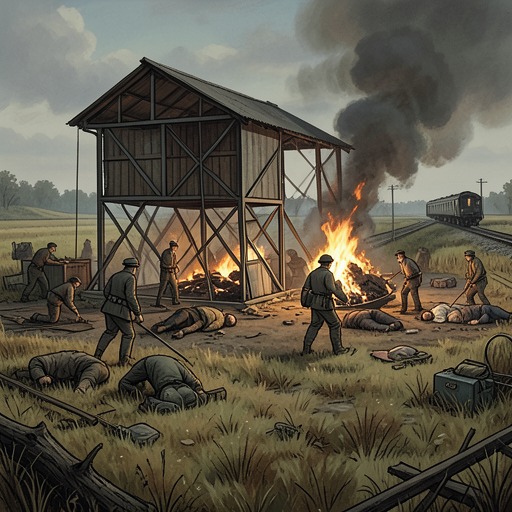
Doll had not visited Sector 4IIIb(i) since July, when he accompanied Heinrich Himmler on a day-long inspection. Returning by truck, he and Szmul approach a mound with Prufer and other officials standing nearby. The meadow begins roughly ten metres beyond it, but the site announces itself before Doll reaches the field: he can hear the remains popping, splatting, and hissing, as well as smell them. The sounds make the work impossible to treat as a distant administrative abstraction.
Doll insists on his own normality and disavows sentimentality, explaining his conduct to himself through loyalty to Germany and the regime’s claims about national good and harm. That self-justification sits beside the physical evidence in front of him. The field is not a symbolic landscape imposed by an observer; it is a place where the disposal process is audibly and visibly under way. When Prufer reports that Blobel tried to blow up the bodies at Culenhof, Doll asks what that would have achieved. Prufer says it did not work and that the upper portions were simply left there. The failed attempt underscores that destroying remains is not a single, clean action: each method leaves material behind.
Doll later describes the surface as undulating like a lagoon at a turning tide, with geyser-like eruptions and pieces of turf leaping into the air. He calls for Szmul, who has descended from the truck into the scene. The comparison to a landscape in motion is inseparable from the process beneath it: the ground itself seems to answer the work of burning and disposal. The meadow is both the site of the operation and evidence of its failure to make death disappear.
The pyre and its operation
Doll records the practical problem in blunt terms: naked bodies do not catch fire easily. Initial attempts using wooden planks produce only modest accumulations and little progress. Szmul, the Sonderkommando leader, then supplies a series of suggestions that Doll says prove decisive. The first is to maintain a single pyre rather than several separate fires; the second is to keep it burning continuously, twenty-four hours a day. These principles convert a faltering effort into a permanent process.
The third measure is to use liquefied human fat to assist combustion. Szmul organizes run-off gutters and teams to ladle the fat back onto the fire. Doll notes that the procedure saves considerable gasoline and reminds himself to make sure Blobel and Benzler are told about the saving. That detail reveals the project’s chilling fusion of murder and economy: a technique devised to sustain the burning is also evaluated as a reduction in fuel costs. The officials’ attention to efficiency does not soften the violence; it shows how thoroughly the violence has been absorbed into routine calculation.
The fire’s intensity creates its own technical obstacle: at times it is too hot for workers to approach. Under Szmul’s direction, the Sonderkommando prisoners construct a vast lattice from warped railway tracks, a structure Doll compares in size to a cathedral in Oldenberg. Workers load it using wide ladders and hoists, then retreat to wheeled towers from which they feed the fire, sometimes throwing in pieces by the bucketful. Doll likens the towers to siege engines. The comparison makes the operation resemble a machine of war, while the monumental scale of the structure gives the process an industrial, engineered form.
At night, the tracks glow red, and Doll says that even with his eyes closed he continues to see the image of a huge black toad with illuminated veins. The vision registers the pyre’s persistence beyond the immediate act of watching: the fire’s pattern remains with him after he looks away. Meanwhile, the nocturnal conflagrations provoke an angry complaint from Lothar Fey of the Air Defence Authority. The flames cannot be fully contained within the operation’s intended secrecy; their light and smoke become a problem for other institutions.
Contamination, exposure, and significance
The effects reach beyond the pyre. Doll makes Prufer taste the local water, explaining that he had to drink it himself after being invited to the civic centre in Old Town to face a delegation of local officials. They say that the water remains undrinkable however many times it is boiled. The remains have begun to ferment, and the water table has been breached. Doll warns that the smell will become unbelievable; Prufer replies that it is already so. The exchange makes contamination an immediate public consequence, not merely a prediction about the site.
Doll’s later drive back from the area extends that exposure into the journey. While the guards sleep and he drives, he repeatedly pulls over to lean out of the window and smell the air. It is as bad as he has known it, and keeps getting worse. His description of feeling trapped in a dream of an unstoppable eruption of filth gives the pollution a bodily, engulfing form. The attempt to remove the evidence has instead produced a smell that follows the officials beyond the field and a contamination that enters the water supply.
The project’s material consequences sharpen the account’s broader historical argument. In a later conversation, Professor Entress explains that the gas chambers and crematories were means of accelerating killing, economizing, and sparing the killers’ nerves; bullets and pyres, he says, would have accomplished the same end because the perpetrators had the will. That reflection places Spring Meadow’s improvised pyre within a larger system of extermination without making the project’s specific methods incidental: here, the remains must be burned, the ashes ground, the fuel economized, and the work kept running around the clock.
Doll’s narration repeatedly exposes the distance between administrative intention and physical result. The project is meant to suppress traces, yet the field erupts, the fires illuminate the night, the water becomes undrinkable, and the odor worsens along the road. Its procedures depend on Szmul’s coerced expertise, but the officials discuss that expertise as a means to improve throughput and save gasoline. Spring Meadow therefore becomes not only a site of corpse disposal but a record of how the perpetrators’ systems operate: through orders, delegated labor, technical adjustment, and cost calculation, with consequences that their own machinery cannot keep buried.